In 2010, I set up this blog as an efficient means of communicating with my friends and family while I was away at Marine Corps boot camp. My dad posted portions of my letters, as well as general information as to what I was doing on any given day. Now, feel free to bookmark this page and check for updates on what I'm up to. Thanks for reading!
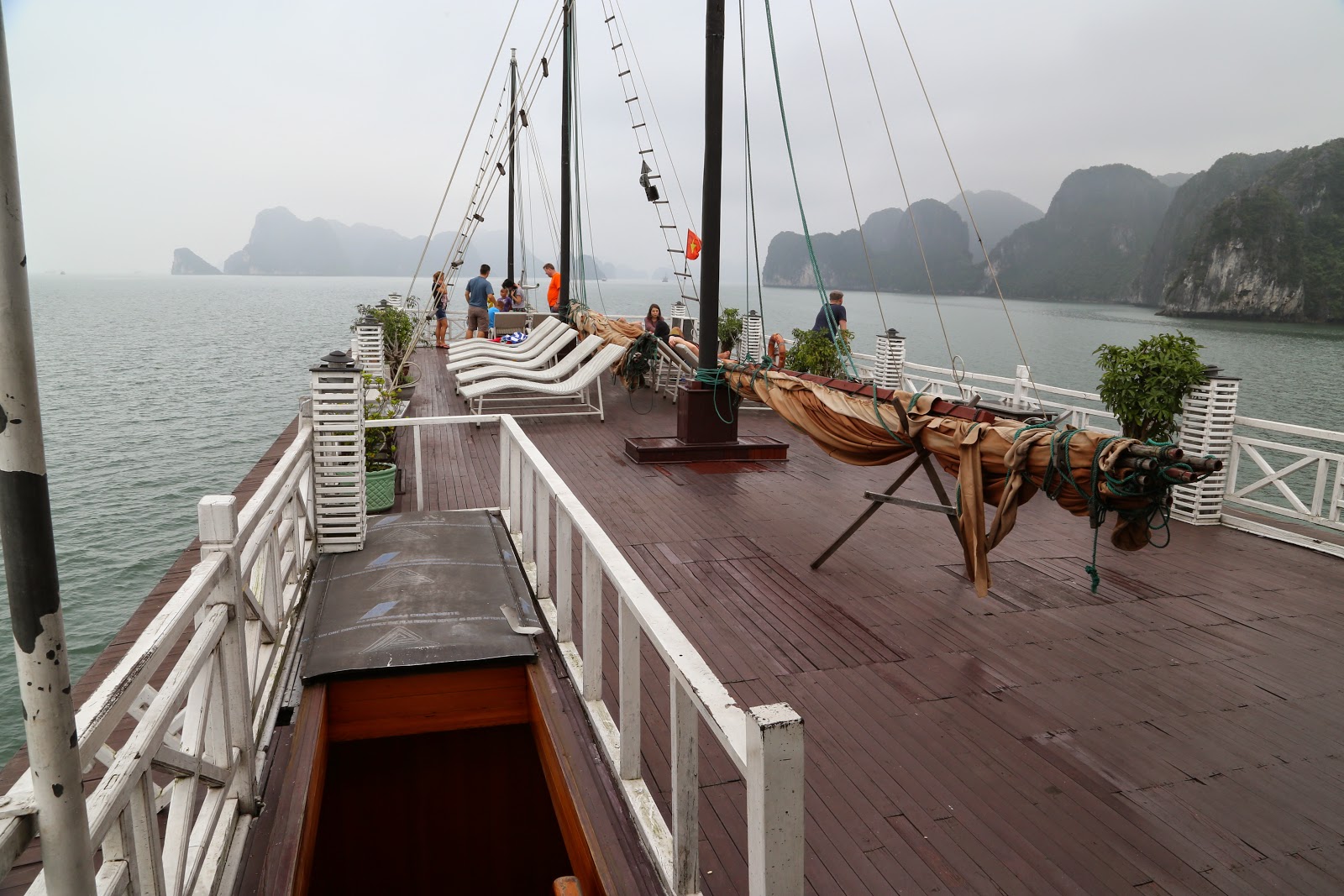
Maybe it's because 2014 is coming to a close, but I feel like there is no better time than to share pictures from my travels this year (well...six months ago would have been best). Anyway, here's a few pictures from my trip to Ha Long Bay, northern Vietnam, in April. It is a UNESCO World Heritage Site and where they filmed the James Bong flicks Tomorrow Never Dies and TheMan with the Golden Gun. Enjoy!
We started our adventure in Ha Long Bay off with
a four-hour bus ride from Hanoi. On the way back, I'm happy to say
I spent the entire time turned around chatting with fellow travelers from
Norway and the UK. My sore neck was absolutely worth it.
Our fearless captain.
None of my blog entries are complete without
a picture of a flag.
We were shown how the locals fish for oysters,
and eventually turn them into jewelry!
I spent one night on the first house - bungalow - on the left.
I ran out of water for the evening before I finished my shower. Woops.
When I think about the places I visit, the people I met
always come to mind first. Enjoying lunch with fellow travelers
from France and the United States.
Cat Ba Island
Not the greatest electrical work I've seen,
but I guess it gets the job done.
I wouldn't spend the night here.
Propaganda fascinates me.
Not something you see every day on the side of a busy street.
I don't know why kindergarten-sized plastic chairs are
so ubiquitous, but I saw these everywhere in Hanoi and Ha Long Bay.
As always, thanks for reading, and I hope you enjoyed the pictures!
As I updated my last blog post, I realized I still have a ton pictures from other places I've visited in 2014 that I still haven't posted, including Ukraine, Poland, Vietnam, Malaysia, and Cuba. I try to share my best photographs to take you there. Traveling is a lot of fun, but it certainly comes with headaches: long flights, expensive tickets, travel sickness...my goal is to make you feel like you were there yourself, minus the headaches. I hope I can capture the emotion and history that each location has to offer.
This post features pictures from a place that needs no introduction.
Double electrified fences.
This is where they decided who lived and died: left or right.
My guide said she once gave a tour to someone who recognized his suitcase.
So many faces. Too many faces.
These canisters contained the gas.
Looking up at where the Nazis dropped the gas canisters.
The city of El Calafate, tucked away into the southwestern pocket of Argentina’s Santa Cruz Province, overlooks the wonderfully-blue “Lago Argentino,” or “Argentine Lake.” The quaint tourist town is a gateway to beautiful glaciers, endless Patagonian steppes, and stunning Andean mountain peaks.
Argentina’s Santa Cruz Province sits farther south than both
Australia and New Zealand. It isn’t quite the “End of the World,” as the
bordering “Tierra del Fuego” Province officially holds that title, but it’s
close enough. During a recent trip to Argentina, I jumped at the opportunity to
take a day trip to neighboring Chile. The destination was Torres del Paine
National Park, a short three-plus hours from my home base in El Calafate.
I love maps. Thank goodness they had a "You Are Here" sign at Argentine customs.
This is facing Argentina.
At Argentine
customs – the hill in the distance is Chilean territory. Before that? No man’s
land. I’m sure there are specific GPS coordinates with the exact line of where
Argentina’s territory ends and Chile’s begins, but it is about a 5 minute drive
*that way* to Chilean immigration.
We made it -- Chile!
Our first stop in the Torres del Paine National Park. The "Torres" (towers) are
in the background.
I thought it was interesting to see "Pare" in Chile. In Mexico, "Stop" is written "Alto."
I apologize for the false advertising: I've never been to the Philippines,
so I can't say if it is actually more fun there. Probably warmer, though.
Back home: my hostel had some of the best views in El Calafate.
Less than an hour’s drive away from the densely populated
capital city of Havana lays Las Terrazas,
a nature resort with a seemingly endless amount of palm trees, bushes, and even
a few lakes. The purpose of my trip there wasn’t to swim like some of the
families I saw; no, I was there to zip-line.
I had been zip-lining once before in southern California, so
this wasn’t entirely a new experience for me. However, not every American can
say they’ve zipped over Cuba’s
beautiful landscape wearing little more than a helmet and worn-out shoes. Needless
to say, I jumped at the opportunity when I found out some friends were going.
It wasn’t all fun and games: even after a short bus ride up a hill,
there was some work involved…if you can call it that.
Some people had more excitement than others.
It’s a long way down, but thank goodness for the water!
Luckily, the cameraman was able to find a replacement for this shot.
This country is often called the “World’s Largest Classic Car Museum.”These beauties can found everywhere here,
and they always look good with Cuba’s natural landscape.
I even recorded a video (I’m just glad our guides didn’t
enforce the “two hands on the safety carabiner” rule):
Well, considering the Soviet Union dissolved in 1991, any
authentic accommodation will be at least a few decades old. Just inside the 30
km checkpoint of the Chernobyl Exclusion Zone, the Pripyat Hotel rests in the
heart of Chernobyl City. It was built in 1967 to commemorate the 50th
anniversary of the October Revolution, which led to the establishment of
communism as the dominate party in Russia in 1917. The pink façade of the
two-story building provides a stark contrast to the surrounding grey, mossy
homes that are being slowly reclaimed by nature. Nearby, visitors can see
evidence of what was once a busy bedroom community for the people who worked in
the power plant nearby. Local attractions include an empty Jewish synagogue
(popular before WWII), a Lenin statue, and a small café (with free Wi-Fi)!
Nowadays, visitors are limited to their rooms and the cafe after the sun goes
down, because there isn’t any lighting anywhere else. During the winter, this
means you will probably be eating an early dinner and hitting the hay, because
the sun sets at 4 pm.
Near the entrance to Chernobyl City.
The outside of the Pripyat Hotel.
Although Chernobyl hosts about 17,000 tourists a year,
the overwhelming majority opt for quick, one-day group tours during the summer.
This is the economic choice. However, when visiting a city that is notorious
for its isolation and emptiness, being surrounded by a bunch of chatty
explorers can easily detract from the experience. I decided to invest $2,000
USD on a three-day, two night private excursion with a Ukrainian tour guide –
who spoke very fluent English. I was kicking myself for blowing so much money
in so little time (quick day-tours in a large group goes for about $80/person),
but I was very thankful for my choice afterwards.
Lenin still hasn’t left Chernobyl City.
Enjoying a traditional Ukrainian lunch in the canteen
near my hotel.
The Pripyat Hotel doesn’t get many visitors. The only
other people I saw there were in the room right next to mine; unfortunately, I
could hear them very well, even if I couldn’t understand what they were saying,
because the walls were uncomfortably thin. It is cleaned, organized, supplied,
and fully staffed by a single woman who only speaks Russian. They don’t have
room service, Internet access, phones, and during my first night, toilet paper.
There is no website to visit, or phone number to call to book a room. Logistics
and reservations are made by one of the few licensed tour agencies that work
with the Ukrainian government. The only guests are tourists that decide to
spend the night in Chernobyl.
I’m ready for my stay!
Most structures in the Zone have the same “look”.
The view from inside the canteen’s restroom.
I am very interested in architecture. Growing up in
southern California, I didn’t have to travel very far to see old Spanish
missions, Victorian homes, or modern buildings. There are certain
idiosyncrasies that I noticed exploring the Zone. One unique aspect was that
double doors lead into everywhere: my individual room in the hotel, the
“canteen” where the workers eat, and the apartment buildings in the abandoned
city of Pripyat. By “double doors”, I mean that you have to open two different sets
of doors to get in many of the rooms, which felt odd for the small
accommodation where I was staying. It is kind of like having a mantrap in your
bedroom, except the inner door doesn’t lock, and the outer one hardly closes. My
hotel had two floors, and probably about 12 rooms. My room was quaint: three
knee-high beds took up most of the ground area in the main room, which had just
enough space to fit my one bag. I welcomed the colorful curtains that seemed to
balance out the sad ambience of the uninhabitable buildings outside. The restroom: basic. It was interesting trying
to take a shower in an elevated bathtub without a curtain. Sitting down while
holding a bar of soap in one hand and the shower head in the other got the job
done. I was thankful for the hot water, even if the pressure was low. I’d like
to think all the exposed pipes make it easier for repair. A nice touch I
noticed was that the plastic light switches in my hotel were exactly the same
as the ones I saw in the Polissya Hotel that was abandoned 30 years ago –
that’s when I knew my experience was authentic.
I knew my experience was authentic when I saw this switch in my own hotel room.
This building was once a Jewish synagogue before WWII.
The Polissya Hotel: Not unlike the one I stayed in
nearby.
My video walkthrough of the Pripyat Hotel in
Chernobyl City.